
Self-Locking Principle of a Linear Screw Stepper Motor
A linear lead screw motor, also known as a linear stepper motor, combines a stepper motor and a lead screw into an integrated unit. The self-locking characteristic of the trapezoidal (T-type) lead screw is a key advantage of this design. 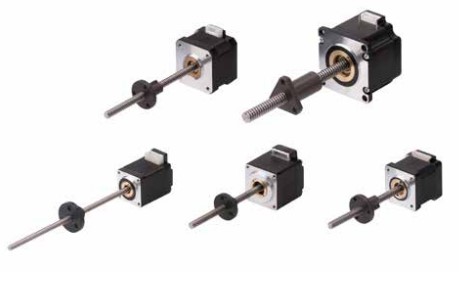 The self-locking capability of a linear lead stepper motor is fundamentally based on the interaction between the inclined plane and friction. This principle can be intuitively understood through a classic physics model: when the helical thread of the lead screw is unrolled, it forms an inclined plane. In this model, the screw threads act like a ramp wound around a cylinder, while the nut behaves like a slider moving along the ramp. The critical "slope" of the ramp is determined by the thread lead angle. Self-locking occurs when the angle of the inclined plane is small enough that the downward force generated by the weight or load cannot overcome the maximum static friction on the slider, preventing it from sliding down. This condition can be expressed mathematically as: thread lead angle (λ) ≤ equivalent friction angle (ρ). When this condition is met, the nut cannot cause the lead screw to rotate, regardless of the axial load. This ensures stable and reliable self-locking, keeping the device securely in position even when the power is off. Where: Thread lead angle (λ): λ = arctan (P / (π × d₂)), where P is the thread pitch and d₂ is the screw's mean diameter. Equivalent friction angle (ρ): ρ = arctan (μ / cosβ), where β is the half-angle of the T-type (trapezoidal) thread, typically 15°.
The self-locking capability of a linear lead stepper motor is fundamentally based on the interaction between the inclined plane and friction. This principle can be intuitively understood through a classic physics model: when the helical thread of the lead screw is unrolled, it forms an inclined plane. In this model, the screw threads act like a ramp wound around a cylinder, while the nut behaves like a slider moving along the ramp. The critical "slope" of the ramp is determined by the thread lead angle. Self-locking occurs when the angle of the inclined plane is small enough that the downward force generated by the weight or load cannot overcome the maximum static friction on the slider, preventing it from sliding down. This condition can be expressed mathematically as: thread lead angle (λ) ≤ equivalent friction angle (ρ). When this condition is met, the nut cannot cause the lead screw to rotate, regardless of the axial load. This ensures stable and reliable self-locking, keeping the device securely in position even when the power is off. Where: Thread lead angle (λ): λ = arctan (P / (π × d₂)), where P is the thread pitch and d₂ is the screw's mean diameter. Equivalent friction angle (ρ): ρ = arctan (μ / cosβ), where β is the half-angle of the T-type (trapezoidal) thread, typically 15°. Advantages of linear screw motors
In linear screw motors, the self-locking principle offers the following advantages:1. Maintaining Position During Power Outages (Core Advantage)
Position retention during power-off is a key benefit of the self-locking mechanism, particularly useful for linear lead screw motor systems installed vertically or designed to resist external forces (such as spring tension). While the motor is powered, its electromagnetic torque actively drives the lead screw to achieve precise linear motion. When the motor is powered off, the driving force disappears, and the load's gravity or external forces may act as a back-driving force, attempting to push the nut and rotate the lead screw in reverse. At this point, the self-locking mechanism of the T-type lead screw comes into play. Because its thread lead angle satisfies the self-locking condition (λ ≤ ρ), the back-driving force generated by the load cannot overcome the static friction between the screw and nut threads. As a result, the system remains stably positioned when power is off, achieving reliable position locking. In contrast, screws without self-locking capability (such as ball screws) cannot effectively counteract the load's gravitational force when power is lost, which may cause the mechanism to slide downward. Therefore, additional mechanical brakes or brake mechanisms are often required, which not only increase system cost but also add structural complexity and potential points of failure.2. Simplifying System Design and Reducing Costs
Thanks to the self-locking capability of the T-type lead screw, the system often no longer needs to be equipped with an external electromagnetic brake. This not only directly reduces component costs but also frees up more space for equipment design. In addition, without a brake, the system does not require separate control circuits or signals, helping to simplify the overall circuitry and reduce control program complexity.