
- Home
- Technical College
- LINEAR STEPPER MOTORS
- Thrust Generation Principle of a Linear Lead Screw Motor
Thrust Generation Principle of a Linear Lead Screw Motor
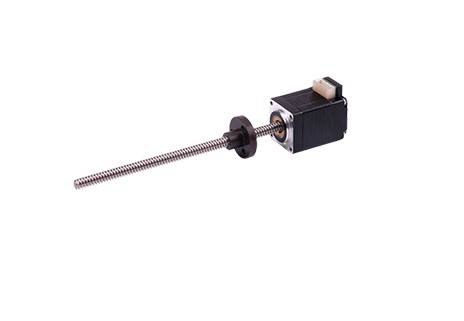
The thrust of a linear lead screw motor is essentially the result of efficiently converting rotational motion into linear force. Specifically, the torque generated by the motor drives the rotation of the lead screw. The helical groove on the screw functions like a continuously extended inclined plane, which converts and amplifies the rotational tangential force into strong axial thrust through the nut, enabling precise linear movement of the load.
Thrust Calculation Formula and Analysis of a Linear Lead Screw Motor
Thrust calculation formula: F = (2 * π * η * T) / P
Note: F: Axial thrust, in newtons (N). T: Input torque, in newton-meters (N•m). P: Screw lead, in meters (m). η: Forward transmission efficiency. π: Pi.
The essence of this formula lies in the principle of work conservation. In other words, the work done by the motor when driving the lead screw through one full revolution is approximately equal to the work done by the screw in pushing the load linearly over one lead distance (neglecting losses). Derivation process: Rotational work: Wrot = 2 * π * T (torque × rotation angle); Linear work: Wlin = F * P(thrust × displacement); Considering efficiency: (2 * π * T) * η = F * P; By rearranging the equation, we obtain: F = (2 * π * η * T) / P。
Parameter Analysis of the Thrust Calculation Formula for a Linear Lead Screw Motor
1. T — Input Torque
T represents the input torque, the fundamental source of thrust, derived directly from the rotor output of a stepper motor or servo motor. Two key points require special attention when calculating this value:
Torque-speed relationship: A motor's torque varies with speed. Generally, as speed increases, torque decreases. Therefore, it's essential to determine the torque value at the specific operating speed.
Detent torque effect: Stepper motors have a unique magnetic reluctance effect that generates a certain amount of detent torque even when the motor is not powered. This directly affects the motor's starting torque.
2. P — Lead
P denotes the lead, which serves as a regulator between thrust and speed and is a core trade-off parameter in design.
In the formula, lead is inversely proportional to thrust, representing a "lever effect": When a small lead (fine thread) is selected, it's equivalent to using a lever with a long arm—requiring less input torque to generate a larger thrust, but resulting in slower linear motion. Conversely, with a large lead (coarse thread), it's like using a lever with a short arm—achieving higher linear speed, but requiring greater input torque to produce the same thrust.
3. η — Transmission Efficiency
η represents the transmission efficiency, which reflects the degree of energy loss due to mechanical friction and serves as a key indicator of system performance. Common T-type lead screws, which rely mainly on sliding friction, have relatively low efficiency—typically between 20% and 40%. The efficiency can be calculated using the following formula: η = tan(λ) / tan(λ + ρ), where λ is the lead angle and ρ is the equivalent friction angle.
This relationship explains why, when the lead angle is less than or equal to the friction angle (λ ≤ ρ), the efficiency drops below 50% and self-locking occurs. In contrast, ball screws, which operate with rolling friction, achieve efficiencies as high as 90%–95%. It's important to note that low efficiency means most of the motor torque is consumed in overcoming friction rather than generating effective thrust, leading to increased system heat and energy loss.
Calculation Example of the Screw Thrust of a Linear Lead Screw Motor
Consider a vertically mounted linear lead screw motor equipped with a T-type screw for lifting a heavy load. The given parameters are as follows: motor output torque T = 1 N•m, screw lead P = 5 mm (0.005 m), and transmission efficiency of the T-type screw η = 30% (0.3).
Thrust Calculation Process: F =(2 * π * 0.3 * 1)/ 0.005 ⇒ F ≈(1.884)/ 0.005 ⇒ F ≈ 376.8N
Analysis:
This motor produces approximately 377 N of axial thrust. Based on the gravitational acceleration g = 9.8 m/s², this thrust can lift a load of about 38.5 kg vertically. If the screw lead is increased from 5 mm to 10 mm while keeping all other parameters constant, the thrust will be halved to around 188 N. As a result, the load capacity decreases, but the linear speed doubles.
If the T-type screw is replaced with a ball screw with 90% efficiency, the thrust increases to about 1130 N under the same torque—roughly three times the original force. This clearly demonstrates the significant effect of transmission efficiency on thrust output.
Factors to Consider in the Practical Use of Linear Screw Motors
1. Thrust-Speed Curve: The motor's output torque decreases as speed increases, so the linear thrust provided by the system is not constant. At higher speeds, thrust drops significantly. When selecting a motor, it is essential to refer to the torque-speed curve and comprehensively evaluate thrust performance across different speeds.
2. Safety Factor Requirements: In actual operation, the system must withstand inertial forces during startup and braking, as well as possible vibration and impact loads. To ensure reliability and extend service life, the theoretically calculated thrust should be divided by a safety factor (typically between 1.5 and 2, or higher) for the final selection.
3. Reverse Drive and Self-Locking: For T-type screws with self-locking characteristics, when the system is subjected to reverse drive (i.e., when an external force causes the screw to rotate), transmission efficiency becomes extremely low, and standard thrust formulas no longer apply. In contrast, ball screws maintain high transmission efficiency in both forward and reverse directions, so thrust formulas remain valid—but they do not provide self-locking capability.
Summary of the Screw Thrust Principle of Linear Screw Motors
The generation of screw thrust in a linear screw motor essentially involves converting the motor’s rotational torque into axial linear thrust through the helical structure of the screw and nut assembly. This process follows clear physical relationships and inherent design trade-offs. The core calculation formula, F = (2π•η•T) / P, shows that thrust is directly proportional to the input torque (T) and transmission efficiency (η), and inversely proportional to the screw lead (P).
As a result, the lead becomes a key design parameter that requires balancing between higher thrust and faster linear speed. In addition, the screw type—such as a lower-efficiency T-type screw or a ball screw with efficiency exceeding 90%—directly affects the thrust output through its transmission efficiency. Understanding this principle forms the foundation for proper selection and design of linear screw motor applications.