
- Home
- Technical College
- MOTOR TECHNOLOGY
- Differences Between Battery-Powered and Battery-Free Absolute Encoders
Differences Between Battery-Powered and Battery-Free Absolute Encoders
An absolute encoder is a sensor used to precisely measure the position of rotating or linear motion systems. Its defining characteristic is that, upon power-up, the device can immediately output the absolute position value without requiring a homing or reference-seeking operation. This position value is unique and non-repeating across the entire measurement range. Depending on whether a battery is employed, absolute encoders differ significantly in maintenance requirements, cost, and overall system reliability.
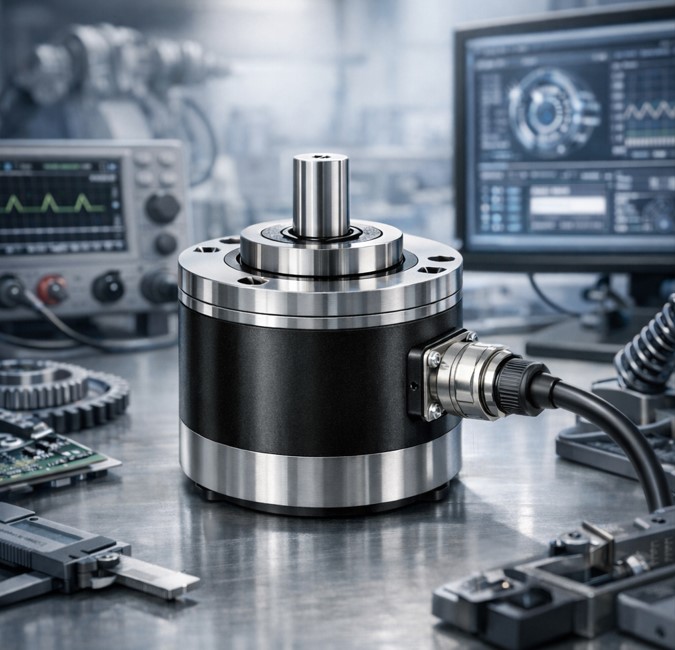
Differences Between Battery-Powered and Battery-Free Absolute Encoders.
Battery-powered absolute encoders typically employ a battery backup scheme. Internally, the encoder integrates a counting circuit and a backup battery. In the event of external power loss, the battery supplies power to the counting circuit to retain the multi-turn counter data, thereby ensuring that multi-turn position information is not lost. This design is well suited for applications that require long-term retention of multi-turn position data.
However, the battery has a limited service life and therefore requires periodic maintenance or replacement; otherwise, loss of position information may occur. Some early generations of absolute encoders relied on batteries to store position data. Such devices essentially achieve position retention by combining electronic interpolation of incremental signals with battery backup, and are therefore sometimes referred to as "pseudo-absolute encoders."
Battery-free absolute encoders typically employ more advanced technologies, such as energy harvesting or non-volatile memory (e.g., FRAM). During shaft rotation, the encoder generates electrical energy via a micro-generator or the Wiegand effect. The harvested energy is then used to write position data into non-volatile memory, enabling long-term retention of absolute position information and providing a lifetime, maintenance-free operating characteristic.
This design eliminates battery-related maintenance requirements and significantly improves system reliability, making it particularly suitable for industrial applications where regular maintenance is difficult or impractical. Although the specific implementation varies among manufacturers, the fundamental objective of battery-free technology is consistent: to reliably store position data through a self-powered mechanism.
Selection Guidelines for Battery-Powered and Battery-Free Absolute Encoders
During the encoder selection process, the choice between battery-powered and battery-free absolute encoders should be based on the specific operating conditions and overall system requirements. Battery-powered encoders typically feature lower initial acquisition costs, but require advance planning for battery maintenance and replacement intervals. Battery-free encoders generally involve higher upfront costs; however, they can substantially reduce long-term maintenance efforts and are therefore better suited for applications with high requirements for system reliability and availability.
In addition, the encoder type—such as single-turn or multi-turn—is an important selection criterion. Single-turn absolute encoders typically do not require a battery to retain position information, whereas multi-turn absolute encoders usually rely on either battery backup schemes or battery-free technologies to ensure reliable storage of revolution count information. Consequently, the selection of a battery-related solution for an absolute encoder should always be aligned with the specific application requirements.