
- Home
- Technical College
- MOTOR TECHNOLOGY
- The Difference Between Sinking Current and Sourcing Current?
The Difference Between Sinking Current and Sourcing Current?
Sinking current and sourcing current are fundamental concepts in digital circuits that describe the direction of current flow at the output port. The key difference between the two lies in the direction of current: sinking current refers to current flowing from the external load into the chip's output port, whereas sourcing current refers to current flowing from the chip's output port to drive the external load. The following sections provide a detailed analysis of the differences between these two, examining them from multiple perspectives.
The difference between sinking current and sourcing current lies in the direction of current flow and the output level state.
Sinking Current: When a digital circuit outputs a low level, current flows from the external load into the chip's output port, with the output port acting as the "sink" for the current. For example, when the MCU's I/O port outputs a low level to illuminate an LED, current flows from the power supply through the LED into the I/O port, which is sinking current.
Sourcing Current: When a digital circuit outputs a high level, current flows from the chip's output port to the external load, with the output port acting as the "source" of the current. For example, when the I/O port outputs a high level to directly drive an LED, current flows from the I/O port to the load, which is sourcing current.
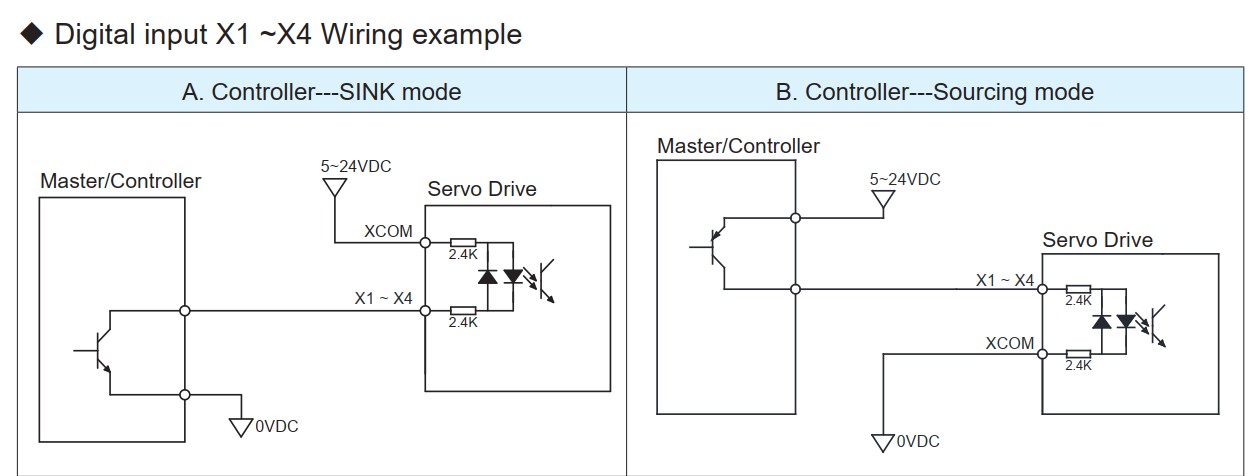
Schematic Diagram of Current Direction for Sourcing and Sinking Current
Distinguishing Between Sinking and Sourcing Currents Based on Application Scenarios and Circuit Design
Typical Applications of Sinking Current: Due to its higher sinking current capability (up to 5–10mA), sinking current is able to effectively absorb load current, making it more suitable for driving common low-resistance loads such as LEDs, relays, and motors. For example, in an LED driver circuit, the LED is connected to VCC through a current-limiting resistor, and the I/O port outputs a low level to light the LED. In this case, the sinking current design is more appropriate.
Typical Applications of Sourcing Current: Sourcing current has a weaker output capability (typically less than 5mA), and is primarily used in charging circuits (such as USB chargers) or in applications requiring stable high-level outputs. If used to drive larger current loads, it may cause the output high-level voltage to drop, which could compromise circuit stability.
Distinguishing Between Sinking and Sourcing Currents Based on Their Impact on Output Drive Capability
Sinking Current and Low-Level Voltage: As the sinking current increases, the output low-level voltage rises due to an increased internal voltage drop. The design must ensure that this voltage does not exceed the maximum low-level input threshold of the logic gate (e.g., TTL standard UOLMAX ≤0.5V), otherwise, logic misinterpretation will occur.
Sourcing Current and High-Level Voltage: As the sourcing current increases, the output high-level voltage decreases due to internal voltage division within the chip. The design must ensure that this voltage remains above the minimum high-level input threshold of the logic gate (e.g., TTL standard requires UOHMIN ≥2.4V) to maintain a stable logic high state.
Parameter Significance: The values for sinking current and sourcing current in the datasheet represent the upper limits of the driving capability. Higher values indicate stronger load-driving capacity. In practical design, since the load current driven by low-level output is typically larger, priority should be given to ensuring that the total sinking current does not exceed the chip's maximum allowable value.