
Stepper Motor Low-Speed Vibration: Causes and Solutions
Significant vibration at low speeds (e.g., 1 rps, 60 rpm) is a common phenomenon in stepper motors. This behavior is primarily attributed to the stepper motor's operating principle and its inherent characteristics under low-speed conditions. The main causes can be summarized as follows:
Reasons for Stepper Motor Vibration at Low Speed
1. Inherent Stepping Characteristics
Stepper motors rotate in discrete steps driven by input pulses. As a result, their motion inherently consists of incremental angular displacement accompanied by periodic torque ripple. At low speeds, this discrete excitation is more likely to induce pronounced vibrations within the mechanical system, making it a fundamental cause of stepper motor vibration under low-speed conditions.
Step Angle Effect: In a typical two-phase stepper motor, the fundamental step angle is 1.8° (i.e., 200 steps per revolution). This means that during continuous operation, the rotor does not rotate smoothly but instead transitions between discrete stable equilibrium positions. Each transition effectively constitutes a pulse excitation applied to the mechanical system.
Energy Release at Low Speed: During low-speed operation (e.g., 1 rps), the time interval between steps is relatively long. As the rotor moves from one equilibrium position to the next, inertia may cause angular overshoot. The electromagnetic restoring torque then pulls the rotor back toward its equilibrium position. If this overshoot–recovery oscillation has not fully damped out before the next pulse arrives, repeated excitation can occur, resulting in sustained low-frequency vibration.
In Summary, low-speed vibration in stepper motors is essentially the combined effect of: Discrete step transitions caused by the step angle + Overshoot oscillation due to rotor inertia + Repeated excitation from periodic input pulses.
2. Mechanical Resonance
Every mechanical system possesses its own natural frequency. A stepper motor, together with its load, can be modeled as a mass–spring–damper system composed of rotor inertia, load inertia, and mechanical stiffness. Consequently, the system exhibits one or more mechanical resonance frequencies.
Low-Speed Resonance Range: Stepper motors commonly experience a resonance zone within a relatively low-speed range. For example, in a standard 1.8° step angle motor (200 steps per revolution), the resonance region typically occurs around 100–200 rpm (approximately 1.6–3.3 rps). An operating speed of 1 rps may fall within or near the edge of this resonance range, depending on the specific motor and load conditions. When the stepping pulse frequency approaches the system's mechanical resonance frequency, vibration amplitude can increase significantly. In severe cases, this may cause the motor to lose steps or fail to start.
Energy Accumulation Under Resonance: Under resonant conditions, the small oscillations generated by each step do not fully decay before the next excitation occurs. Instead, the vibration energy accumulates over successive steps, resulting in pronounced low-frequency oscillation. This energy buildup is one of the key reasons why stepper motor vibration becomes particularly noticeable at low speeds.
3. Drive Control Resolution and Current Regulation
Low-speed vibration in stepper motors is influenced not only by mechanical and electromagnetic characteristics, but also by the drive control strategy.
Full-Step and Half-Step Operation: When the driver operates in full-step or half-step mode, each step produces relatively large torque variation. The rotor transitions abruptly from one equilibrium position to the next, resulting in noticeable torque ripple. This "discrete-step" excitation further amplifies the inherent vibration at low speeds.
Limitations of Microstepping: Although microstepping drivers are widely used today (e.g., subdividing a 1.8° step into up to 25,600 microsteps), they can significantly improve low-speed smoothness. However, if the microstepping resolution is insufficient, or if the driver's current control is not sufficiently smooth (e.g., due to poor sine-wave approximation), the motor may still experience residual torque ripple and vibration at very low speeds. In theory, microstepping can effectively suppress vibration, but it cannot eliminate vibrations caused by factors such as cogging torque.
4. Mechanical Load and Coupling Factors
Low-speed vibration in stepper motors is also strongly influenced by the mechanical load and the coupling configuration. The main factors include the following:
Load Inertia Mismatch: If the load inertia is significantly larger or smaller than the rotor inertia, the dynamic behavior of the system can become unstable. An improper inertia ratio may cause oscillation during acceleration, deceleration, or even steady-state operation at low speeds. Proper inertia matching is essential to minimize vibration and ensure smooth motion.
Coupling Misalignment or Insufficient Rigidity: If the coupling between the motor shaft and the load has backlash, insufficient torsional stiffness, or installation misalignment (such as eccentric mounting), the small torque fluctuations from each step can excite vibration in the transmission components. This may result in increased noise, oscillation, and mechanical wear.
Structural Resonance Amplification: Even small inherent motor vibrations can be amplified if they coincide with the natural frequency of the mounting structure, base plate, or supporting bracket. When structural resonance occurs, vibration levels can increase significantly throughout the entire system.
5. Inherent Torque Ripple and Cogging Torque
In addition to mechanical and control-related factors, stepper motors also exhibit torque fluctuations that originate from their electromagnetic structure.
Cogging Torque: Cogging torque is an inherent characteristic of permanent magnet motors, including stepper motors. Even when the motor is unpowered, rotating the shaft by hand produces a noticeable "stepping" or detent resistance. This phenomenon arises from the magnetic interaction between the rotor's permanent magnets and the stator teeth. During low-speed operation, cogging torque introduces torque fluctuations, which can lead to vibration.
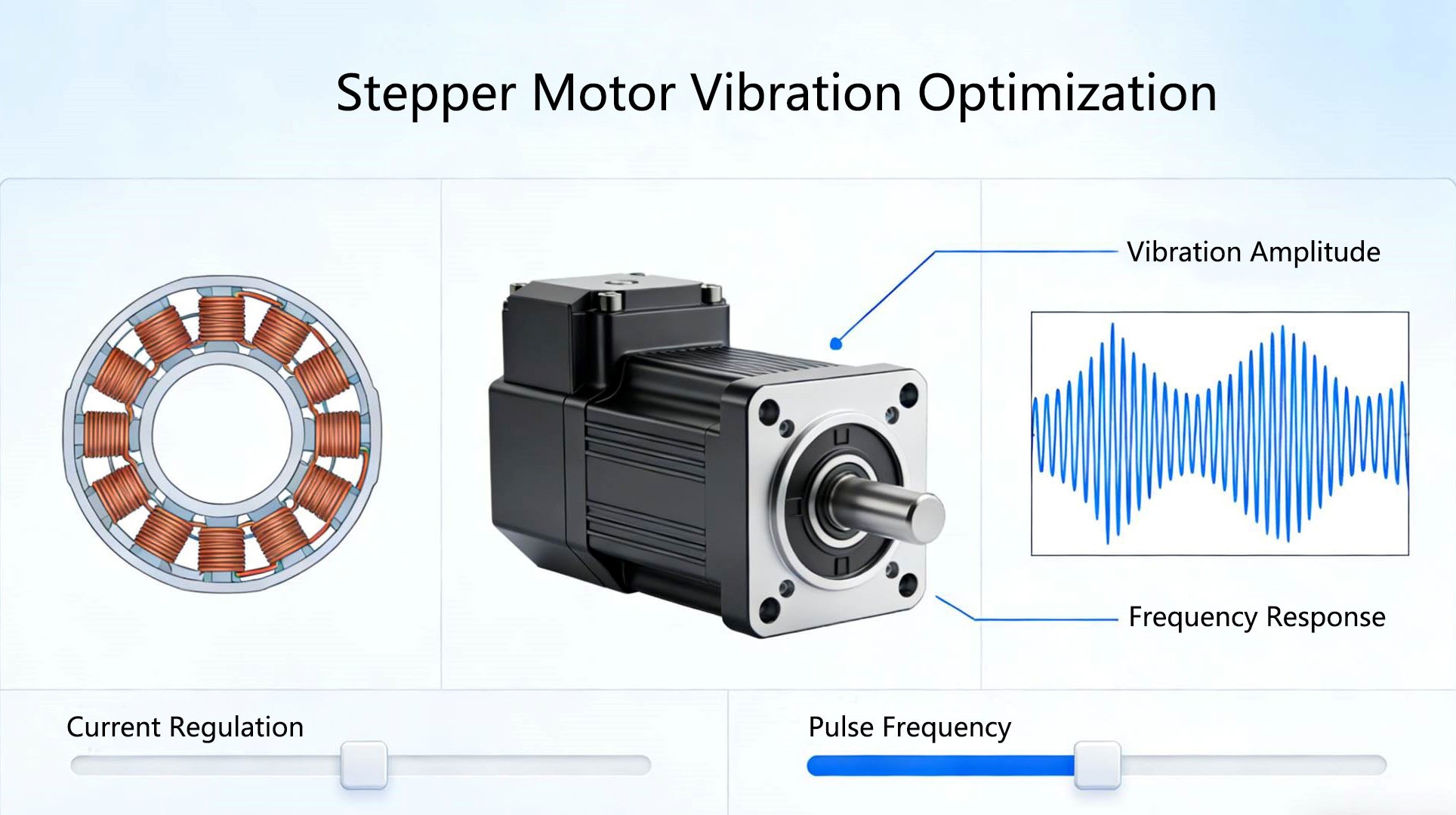
Stepper Motor Vibration Optimization
How to Reduce Stepper Motor Vibration at Low Speed?
If excessive vibration occurs during low-speed operation (e.g., 1 rps), the following approaches can help mitigate the issue:
1. Increase Microstepping Resolution
This is the most commonly used and effective method. By increasing the microstepping setting of the driver (for example, 10 microsteps, 20 microsteps, or higher), the torque variation per step is reduced. This decreases step-induced excitation and results in smoother rotor motion, significantly improving low-speed performance.
2. Avoid the Resonance Range
If the application allows, slightly increasing or decreasing the operating speed can help move the system away from its mechanical resonance range. Alternatively, optimized acceleration and deceleration profiles can be used to pass quickly through the resonance zone, minimizing vibration buildup.
3. Optimize Driver Parameters
Some advanced drivers allow adjustment of parameters such as current waveform shaping, idle current reduction (half-current setting), and dynamic current control. Proper tuning of these settings can help minimize torque ripple and improve smoothness during low-speed operation.
4. Improve Mechanical Coupling and Mounting
Ensure that the coupling is properly aligned (coaxial) and securely fastened, and that the mounting base provides sufficient rigidity. In some cases, introducing a flexible coupling between the motor and the load can help absorb a portion of the vibration.
5. Add Mechanical Damping
Where feasible, damping can be increased to improve system stability. For example, installing a small-inertia flywheel on the motor shaft can act as a mechanical filter, helping to smooth speed fluctuations and reduce vibration.