
EtherCAT vs Ethernet: What's the Difference?
1. Fundamental Differences Between EtherCAT and Ethernet
EtherCAT Overview
EtherCAT (Ethernet for Control Automation Technology) is a real-time industrial Ethernet communication technology based on the Ethernet physical layer. It was proposed and promoted by Beckhoff Automation in Germany, and its applications in automation, measurement, and testing are defined within the IEC 61158 standard. The technology is designed for industrial control applications that demand high real-time performance and communication determinism. Its key characteristics include low communication latency, minimal jitter, and high bus bandwidth utilization. Consequently, EtherCAT is widely used in real-time control systems such as high-speed I/O and motion control.
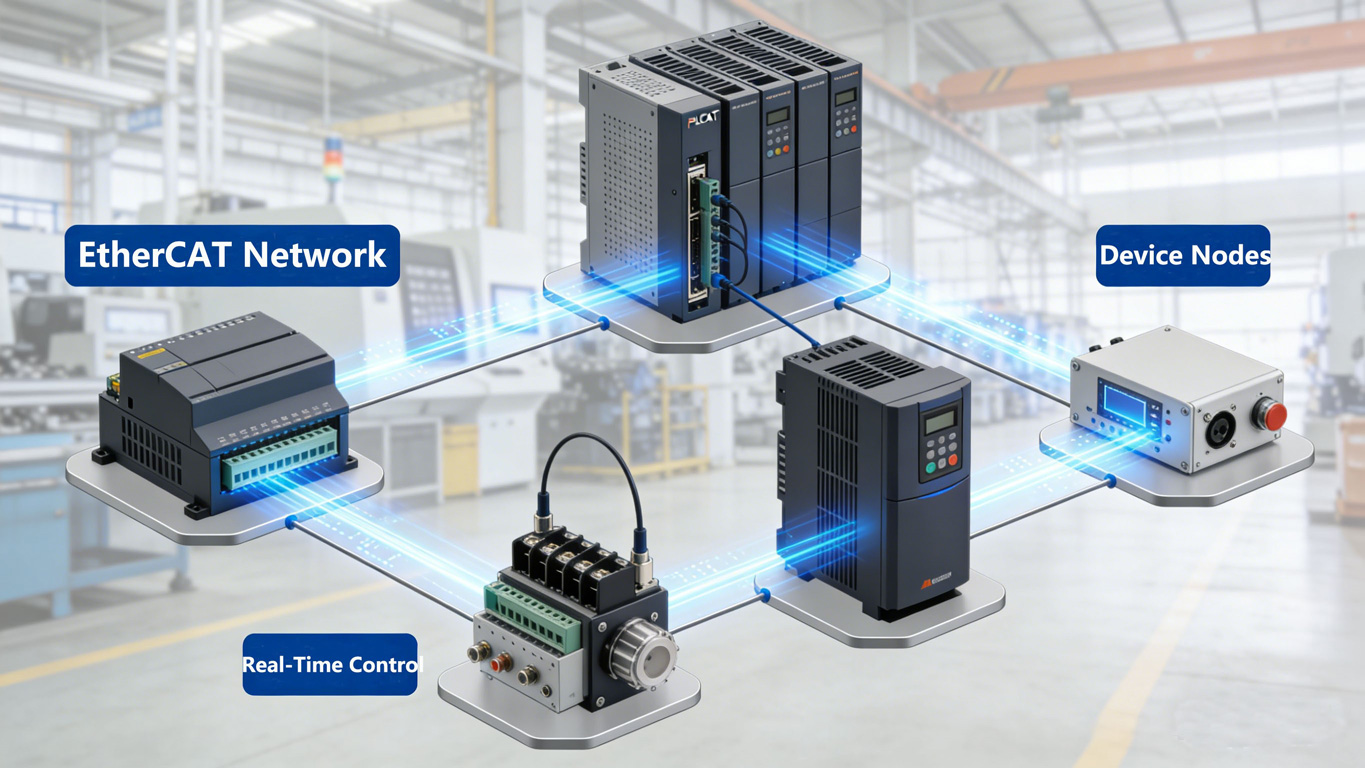
EtherCAT Network
Ethernet Overview
Ethernet is a general-purpose local area network (LAN) communication technology. Its standards are defined by the IEEE 802.3 specification and it is ubiquitous in office networks, information systems, and non-real-time communication in industrial automation. Ethernet was originally conceived for data communication, emphasizing versatility and interoperability, and therefore does not provide strict guarantees for real-time performance or determinism. When enhanced for industrial environments, it evolved into Industrial Ethernet. For example, in Siemens automation systems, the ISO or TCP connections supported by modules like CP343-1 or CP443-1 are communication protocols running over Industrial Ethernet.
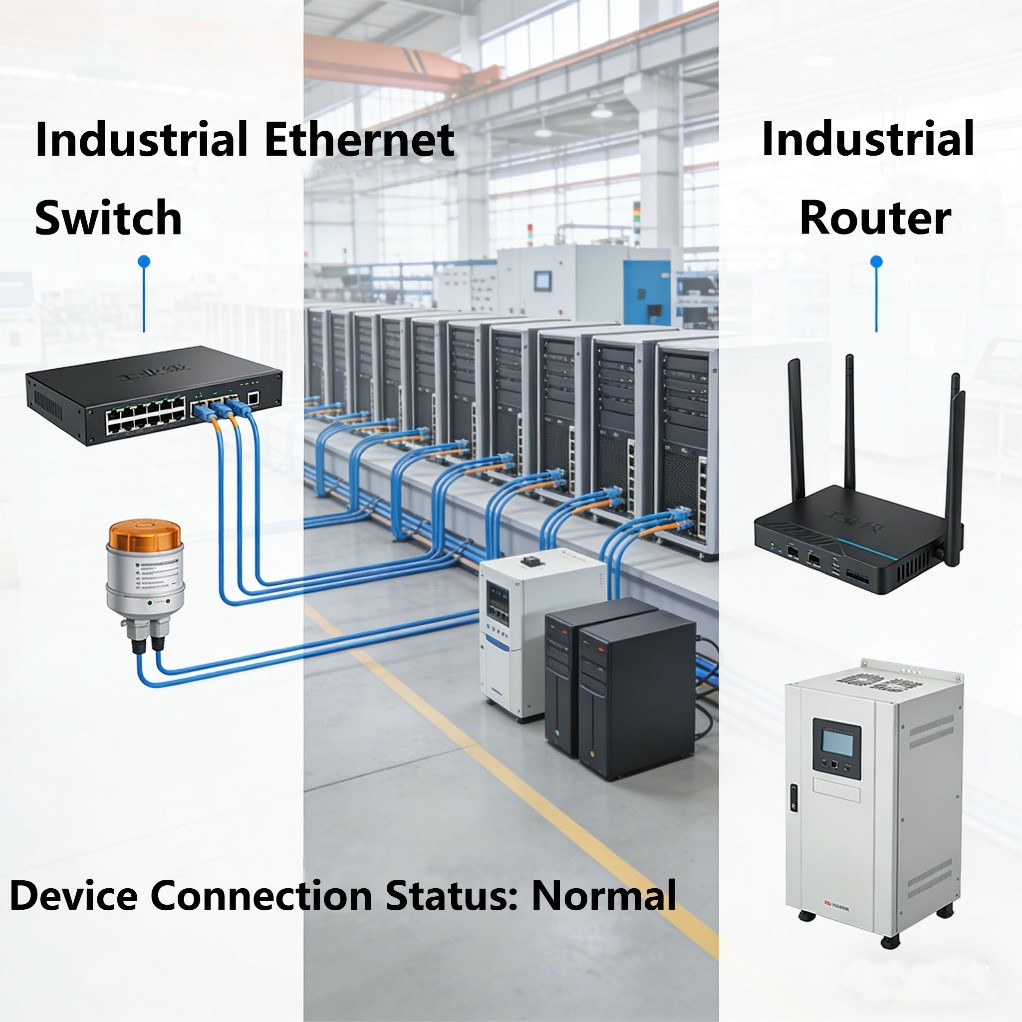
Ethernet Network
2. Differences in Communication Principles
EtherCAT Communication Principle
EtherCAT encapsulates process data directly within standard Ethernet frames, identified by the dedicated EtherType 0x88A4. Its communication mechanism is optimized for short-cycle process data exchange. Real-time data transmission bypasses the traditional TCP/IP or UDP/IP protocol stacks altogether, drastically reducing processing overhead and latency. During system startup, the EtherCAT master configures the slaves and establishes process data mapping. A single EtherCAT frame can contain multiple datagrams, enabling read/write access to slaves via physical or logical addressing. For non-real-time communication (e.g., parameter configuration), EtherCAT uses a mailbox mechanism that supports TCP/IP without interfering with real-time process data transmission.
Ethernet Communication Principle
Traditional Ethernet employs a general-purpose data communication model based on shared media and access control rules. Early Ethernet used the Carrier Sense Multiple Access with Collision Detection (CSMA/CD) mechanism, where data collisions caused retransmissions, leading to unpredictable latency and jitter. Even in modern, full-duplex switched networks, data transmission relies on layered protocol stack processing. Communication timing remains influenced by network load, queuing, and switch scheduling policies, making it suitable for applications where precise timing is not critical.
3. Differences in Data Transmission Methods
EtherCAT Data Transmission Method
EtherCAT uses an "on-the-fly" processing mechanism. A data frame sent by the master passes sequentially through each slave device. Each slave reads or writes its relevant data as the frame streams through, without receiving, storing, and then forwarding the entire frame. This allows a single frame to exchange data with numerous slaves. Each slave introduces only a nanosecond-level delay, maximizing bus bandwidth utilization and minimizing overall system communication latency.
Ethernet Data Transmission Method
Traditional Ethernet typically uses a "store-and-forward" method. Network devices (like switches) must receive, buffer, and perform a CRC check on an entire Ethernet frame before forwarding it. Data packets are forwarded hop-by-hop, with transmission latency accumulating at each node and being affected by network load and switch scheduling. This can lead to queuing delays and timing uncertainty, making it ideal for general data communication but less ideal for hard real-time control.
4. Differences in Application Scenarios
Application Scenarios of EtherCAT
Due to its low latency, high synchronization accuracy, and excellent determinism, EtherCAT is primarily used in industrial control applications with stringent real-time requirements. This includes multi-axis motion control, servo drives, robotics, high-speed I/O acquisition, and distributed control systems. In these applications, the control system must complete data exchange and synchronized control for a large number of devices within a fixed, very short communication cycle (often < 1ms), a demand EtherCAT is designed to meet.
Application Scenarios of Ethernet
Ethernet is better suited for applications with lower real-time demands but higher requirements for system openness, compatibility, and data throughput. In industrial automation, Ethernet is commonly used for communication between supervisory computers and controllers, device configuration, data acquisition for monitoring (SCADA), and Manufacturing Execution Systems (MES)—applications residing at the information and management layers.
In practical industrial systems, EtherCAT and Ethernet often assume complementary roles. EtherCAT is typically deployed at the field and control layers for deterministic, real-time device communication. In contrast, standard (or Industrial) Ethernet handles data flow between the control, supervisory, and enterprise layers. This combination leverages the strengths of each technology, forming a robust and efficient network architecture for modern automation.