
- Home
- Technical College
- MOTOR DRIVES
- The Importance of Load Inertia Ratio: Calculation, Selection, and Optimization
The Importance of Load Inertia Ratio: Calculation, Selection, and Optimization
In the design and tuning of motion control systems, the load inertia ratio is a fundamental and critical parameter. It directly affects the system's dynamic response, positioning accuracy, stability, and reliability. Whether in high-precision semiconductor equipment or general industrial automation systems, proper inertia matching is essential for achieving the intended system performance.
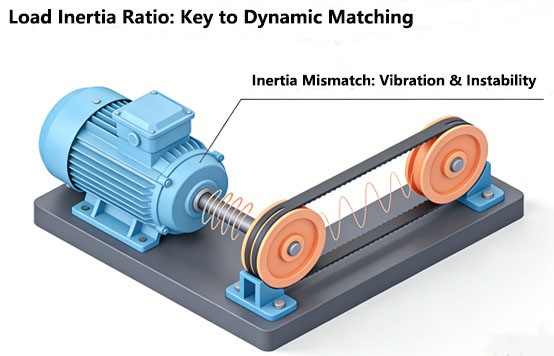
I. Analysis of the Effects of the Load Inertia Ratio
The load inertia ratio (R = JL / JM) is defined as the ratio of the total load moment of inertia (JL), reflected to the motor shaft, to the motor rotor inertia (JM). Its effects are mainly observed in the following three aspects:
1.1 Physical Characteristics: Inertia Matching
The load inertia ratio represents the relationship between load inertia and motor drive capability. When the inertia ratio is too high, the system's acceleration capability decreases, and overshoot and oscillations are more likely to occur during deceleration, thereby degrading positioning accuracy and dynamic stability.
1.2 Control Characteristics: Gain Tuning Constraints
Modern servo motors and stepper drives achieve precise motion through multi-loop control. The gains of each control loop have well-defined mathematical relationships with the load inertia ratio. For example, the speed loop bandwidth is ideally proportional to √(1/R), while the system's natural frequency determines the upper limit of stable dynamic response. As the inertia ratio (R) increases, the range of stable gain settings becomes narrower, making system tuning more challenging. Without an accurate inertia ratio, auto-tuning results tend to be less reliable, and parameters often require iterative adjustment.
1.3 Performance Prediction: Dynamic Capability Assessment
The load inertia ratio can be used to quantitatively evaluate key system performance metrics. For example, acceleration capability can be calculated based on the motor's peak torque and total inertia, allowing precise estimation of maximum angular acceleration. In applications with frequent start-stop cycles, the inertia ratio affects the motor's RMS current and temperature rise. A high inertia ratio can also introduce mechanical stress on transmission components, reducing system lifespan. In contouring applications, the inertia ratio directly influences the system's ability to track complex trajectories, thereby affecting following error.
II. How to Calculate Load Inertia?
2.1 Core Formula for Load Inertia
R = JL / JM
JL: Total moment of inertia of all moving parts reflected to the motor shaft (kg•m²); JM: Moment of inertia of the motor rotor (kg•m²).
Moment of inertia describes an object's resistance to angular acceleration and is proportional to the square of the distance of its mass distribution from the axis of rotation.
2.2 Inertia Calculation Models for Common Loads
| Load Type | Formula | Key Points |
| Solid cylinder(about its central axis) | J = (1/8) × m × D² or J = (1/2) × m × R² |
Inertia is proportional to the square of the diameter (or radius) |
| Load through a reduction mechanism | J = m × [P/(2π)]² | smaller lead (P) results in lower equivalent inertia |
| After passing through the deceleration mechanism | JL' = JL / i² | Doubling the reduction ratio reduces inertia by a factor of four |
Golden Rule: All load inertia must be reflected to the motor shaft before calculation.
III. Recommended Load Inertia Ratio Ranges for Servo and Stepper Systems
3.1 Recommended Ranges for Servo Systems
Servo systems, enabled by closed-loop control and advanced algorithms, offer relatively high tolerance to load inertia ratios. However, optimal ranges still vary depending on the application. Modern servo drives, with features such as adaptive control and resonance suppression, can operate at inertia ratios of 30–50.
However, this comes at the cost of reduced system bandwidth and increased tuning complexity.
| Application Scenarios | Recommended Load Inertia Ratio | Performance Focus | Typical Equipment |
| Ultra-high dynamic response | 1:1 ~ 3:1 | Nanoscale positioning, no overshoot, minimal vibration | Semiconductor equipment, precision measurement systems |
| High-precision positioning | ≤5:1 | Fast response, high trajectory accuracy | CNC machine tools, industrial robots, SMT machines |
| General industrial applications | 5:1 ~ 10:1 | Stable operation, balanced cost-performance | Packaging machinery, general automation equipment |
| Low dynamic applications | 10:1 ~ 30:1 | Smooth operation, high load capacity | Large turntables, heavy machinery, conveyor systems |
| Extreme cases | Up to 50:1~100:1 | Point-to-point motion, long acceleration/deceleration times | Specialized heavy-duty equipment |
3.2 Recommended Range for Stepper Systems
Stepper motors operate in open-loop control and are more sensitive to load inertia ratio, which is typically recommended to be within 1–3. Due to their torque–speed characteristics, output torque decreases significantly at higher speeds. Therefore, in high-speed applications, the inertia ratio should be further reduced to maintain stable operation.
| Stepper Motor Type | Recommended Load Inertia Ratio | Key Limitations | Applicable Scenarios |
| Open-loop stepper motor | ≤3:1 ~ 5:1 | Prone to step loss and stalling when limits are exceeded | Low-speed start-stop, cost-sensitive positioning |
| Closed-loop stepper motor | ≤10:1 ~ 30:1 | Improved performance with encoder feedback | Medium-speed applications requiring moderate accuracy |
| High-speed operation | ≤3:1 | Significant torque drop at high speeds | Applications with speeds > 1000 r/min |
3.3 Key Differences Between Servo and Stepper Systems
Selection Guidelines: Servo systems are best suited for applications requiring high dynamic response and positioning accuracy. Stepper systems are more appropriate for low-speed, stable-load, and cost-sensitive applications.
| Characteristics | Servo System | Stepper System |
| Control Method | Closed-loop feedback control | Open-loop (or semi-closed-loop) control |
| Inertia Ratio Tolerance | High (up to 30:1 or higher) | Low (usually ≤10:1) |
| Overload Capacity | Strong, with overload protection | Limited, prone to step loss and stalling |
| High-Speed Performance | Excellent, stable across the full speed range | Significant torque drop at high speeds |
| Tuning Complexity | High, with many parameters | Low, relatively simple |
| Cost | Higher | Lower |
IV. Setting and Optimizing the Load Inertia Ratio
4.1 Optimization in the Design Phase
Optimizing the reduction ratio is one of the most effective and cost-efficient methods for adjusting the load inertia ratio. The reflected inertia scales with the square of the transmission ratio.
For example, in a system with an initial R = 20, increasing the reduction ratio from 5 to 7 results in: Rnew = 20 × (5/7)² ≈ 10.2. In this case, the output speed and torque must also be verified. In terms of motor selection, servo motors can be chosen with higher rotor inertia, provided that torque and speed requirements are met. For stepper motors, the equivalent inertia can be increased by selecting a larger frame size. Structural optimization can further reduce system inertia by minimizing the rotation radius, using low-density materials, and adopting hollow structures.
4.2 Optimization in the Tuning Phase
Once the mechanical structure is finalized, further optimization can be achieved through control parameter tuning. The actual inertia ratio can be obtained using the drive's online inertia identification function, and measured values are typically 10–30% higher than theoretical calculations. For servo systems, dynamic performance can be improved by increasing the speed loop gain and introducing acceleration feedforward. In contrast, stepper systems offer limited tuning flexibility and rely more on proper mechanical matching. To address vibration caused by inertia mismatch, notch filters can be applied to suppress mechanical resonance, while low-pass filters can be used to smooth command signals. However, the phase delay introduced by these filters must be carefully considered.
4.3 Solutions for Excessively High Inertia Ratio
| Problem Description | Possible Causes | Solutions |
| Slow response, large following error | Inertia ratio too high | 1. Increase the reduction ratio 2. Select a motor with higher rotor inertia 3. Enable acceleration feedforward |
| Jitter, oscillation | Inertia ratio too low or mechanical resonance | 1. Reduce control gain 2. Apply a notch filter 3. Improve mechanical rigidity |
| Step loss or stalling (stepper) | Inertia ratio exceeds recommended range | 1. Increase the reduction ratio 2. Use a larger frame size motor 3. Consider closed-loop stepper or servo system |
V. Golden Rules for Load Inertia Ratio in Engineering Practice
5.1 Servo System Design Guidelines
• High dynamic applications (positioning time < 0.1 s): Inertia ratio ≤ 3:1
• General precision applications: Inertia ratio 5:1 – 10:1
• Heavy-load, low-speed applications: Inertia ratio can be relaxed to 20:1 – 30:1, with longer acceleration and deceleration times
• Rigid systems (direct drive, high-rigidity connections): Higher inertia ratios are acceptable
• Flexible systems (belt drives, long shafts): Inertia ratio must be strictly limited
5.2 Stepper System Design Guidelines
• Open-loop stepper systems: Strictly ≤ 5:1, with an ideal value around 3:1
• Closed-loop stepper systems: Up to 10:1 – 20:1 depending on application
• High-speed applications (> 500 rpm): More conservative design required, recommended ≤ 3:1
• Vertical axis applications: Additional gravity load must be considered, requiring a lower inertia ratio
5.3 Selection Workflow
• Calculate load inertia: Accurately determine the inertia of all moving components reflected to the motor shaft
• Preselect the motor: Choose a preliminary motor based on torque and speed requirements
• Calculate inertia ratio: R = JL / JM
• Evaluate matching: Servo systems: R ≤ 10 acceptable, R ≤ 5 preferred, Stepper systems: R ≤ 5 acceptable, R ≤ 3 preferred
• Optimize if necessary: Adjust the reduction ratio or reselect the motor
• Final verification: Confirm that torque, speed, and power requirements are satisfied
The design and optimization of the load inertia ratio spans the entire workflow—from mechanical design and motor selection to control tuning. It represents a balance among system performance, stability, cost, and tuning complexity. As such, there is no single optimal value; instead, the appropriate inertia ratio must be determined based on specific application requirements.