
Analysis of Stepper Motor Lost Steps
The fundamental cause of stepper motor lost steps (also referred to as missed steps) is insufficient output torque to overcome the load resistance, or improper control parameter settings that prevent the rotor from synchronizing with the input pulse commands. Lost-step issues in stepper motors typically manifest as positioning errors, vibration, and abnormal noise. In severe cases, they may result in reduced positioning accuracy or even system shutdown.
From an engineering perspective, the causes of stepper motor lost steps can generally be categorized into several areas: electrical factors, mechanical load factors, control parameter settings, system sizing and matching, and external environmental interference. During troubleshooting, these factors should be analyzed and verified systematically based on the actual operating conditions of the system.
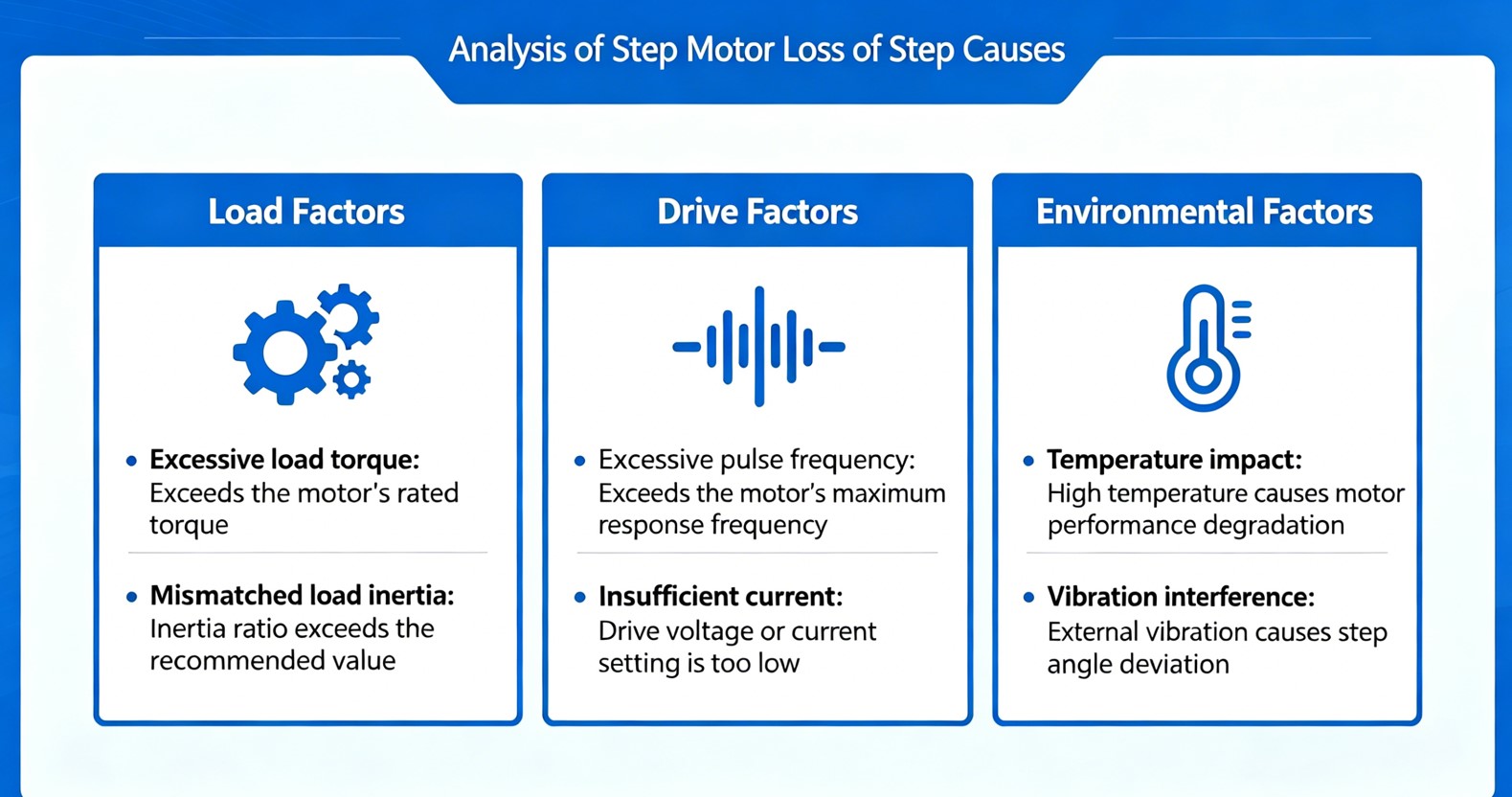
Analysis of Stepper Motor Lost Steps
1. Electrical Causes
Electrical issues are among the most common causes of stepper motor lost steps. In essence, they occur when the drive system cannot continuously and reliably provide sufficient power or stable control signals to the motor.
Improper Drive Current Settings
The drive current directly determines the output torque of the stepper motor. If the current setting is too low, the motor may not generate enough torque to overcome load inertia and mechanical resistance during acceleration, load changes, or high-speed operation, resulting in lost steps. However, increasing the drive current excessively is not always beneficial. Overcurrent conditions can increase the temperature of both the motor and driver, and in severe cases may lead to magnetic saturation, driver protection triggering, or reduced operational stability, all of which can also contribute to lost-step issues.
Insufficient Supply Voltage or Poor Power Stability
During high-speed operation, stepper motors require rapid winding current buildup. If the supply voltage is too low, the current rise rate in the motor windings will be limited, causing a significant reduction in output torque at higher speeds and increasing the risk of lost steps. In addition, insufficient power supply capacity, excessive voltage fluctuations, or poor transient response performance may prevent the driver from delivering stable current output, thereby affecting overall system stability.
Electromagnetic Interference in Control Signals
Stepper drivers rely on pulse signals (PULSE) and direction signals (DIR) from the controller to achieve precise motion control. If signal cables are excessively long, unshielded, improperly grounded, or routed alongside high-power electrical lines, they can become susceptible to electromagnetic interference (EMI). EMI may cause false triggering, missed pulses, or signal distortion, ultimately resulting in positioning errors or lost synchronization.
Driver Faults or Improper Parameter Configuration
Driver hardware faults, such as aging power components, abnormal thermal protection behavior, or control circuit failures, may lead to unstable or abnormal output. In addition, improper configuration of parameters such as microstepping, current limiting, current decay mode, and control response settings can adversely affect motor performance and reduce system stability, ultimately causing lost steps.
2. Mechanical Causes
After electrical and control-related factors have been ruled out, lost-step issues in stepper motors are often associated with load characteristics and the mechanical transmission system. Variations in mechanical resistance, transmission backlash, or structural vibration can directly affect the operational stability of the motor.
Excessive Load or Excessive Load Inertia
When the load torque exceeds the motor's rated output capability, the motor can no longer maintain synchronization with the input pulse commands, resulting in lost steps. This issue is particularly common during startup, rapid acceleration or deceleration, high-speed operation, or sudden load changes. In addition to static load conditions, excessive load inertia can also reduce the motor's dynamic response capability and negatively affect motion synchronization performance.
Excessive Mechanical Resistance or Jamming
Wear, assembly misalignment, or insufficient lubrication in mechanical transmission components can significantly increase operating resistance within the system. For example, worn lead screw bearings, poorly lubricated linear guides, or excessive timing belt tension can all increase motion resistance. If intermittent binding or jamming occurs within part of the mechanism, the instantaneous motor load may rise sharply beyond the available output torque, ultimately causing lost steps.
Loose or Slipping Transmission Components
If components such as couplings, timing pulleys, or fastening structures between the motor shaft and the load become loose, misaligned, or slip during operation, the actual motion may no longer match the commanded position. This type of issue is typically manifested as position deviation or repeat positioning errors, which can easily be mistaken for lost steps. Therefore, the integrity and reliability of mechanical connections should be checked early during troubleshooting.
Mechanical Resonance
Stepper motors may experience resonance when operating within certain speed ranges where the pulse frequency approaches the natural frequency of the mechanical system. Resonance can cause excessive vibration and noise while significantly reducing effective output torque. Under severe resonance conditions, motor stability may deteriorate substantially, eventually leading to lost steps or even motor stalling.
3. Control and Parameter Setting Issues
In addition to electrical and mechanical factors, improper motion control strategies and parameter configuration are also major causes of stepper motor lost steps. This is particularly evident in applications involving high speed, large inertia, or high dynamic response requirements, where control parameters have a greater impact on overall system stability.
Improper Acceleration and Deceleration Profiles
Stepper motors require properly configured acceleration and deceleration profiles to achieve smooth startup and stopping. If the starting frequency exceeds the motor's pull-in frequency (fs), or if the acceleration setting is too aggressive, the rotor may be unable to follow the input pulse commands due to inertia, resulting in lost steps.
Similarly, sudden deceleration or abrupt stopping during high-speed operation can generate significant inertial shock within the system, disrupting synchronization between the rotor and control pulses. For high-inertia load applications, staged acceleration profiles or S-curve acceleration/deceleration control should be adopted to reduce dynamic shock and improve operational stability.
Improper Microstepping Configuration
Increasing the microstepping setting can improve motion smoothness, reduce vibration and noise, and increase theoretical positioning resolution. However, higher microstepping resolutions also require the control system to output higher pulse frequencies. If the controller’s pulse output capability is insufficient, or if the driver response speed cannot meet high-frequency control requirements, issues such as missed pulses, response lag, or loss of synchronization may occur, ultimately leading to lost steps.
Therefore, microstepping settings should be selected based on a comprehensive evaluation of controller performance, motor speed requirements, and overall system dynamic response capability, rather than simply pursuing higher microstepping resolutions.
4. Sizing and Matching Issues
Some lost-step issues in stepper motor systems do not originate during operation, but instead result from improper system design and component selection. Inadequate matching among the motor, driver, and load can directly affect system dynamic performance and operational stability.
Insufficient Torque Margin
If the selected motor only satisfies the theoretical load requirements without adequate safety margin, the system may operate near its performance limit during actual operation. Under conditions such as load fluctuations, friction changes, ambient temperature variations, or deteriorating lubrication, the required torque may temporarily exceed the motor's available output torque, resulting in lost steps. In practical engineering applications, an appropriate torque margin should always be reserved based on operating conditions to ensure long-term system stability and reliability.
Inertia Mismatch
The dynamic response capability of a stepper motor is closely related to load inertia. If the load inertia is significantly greater than the rotor inertia of the motor, acceleration and deceleration become more difficult, reducing synchronization performance and increasing the likelihood of lost steps. In general, the ratio between load inertia and motor rotor inertia should remain within a reasonable range, typically recommended to be below 10:1. For high-inertia applications, a gearbox or speed reducer can be used to reduce the equivalent inertia reflected to the motor side, thereby improving system dynamic performance. However, improper selection of the reduction mechanism—such as low transmission efficiency, excessive backlash, or self-locking characteristics—may also negatively affect system stability and operational performance.
5. Environmental and Other Factors
In addition to system-related factors, external environmental conditions and installation quality issues can also contribute to abnormal stepper motor operation.
Excessive Operating Temperature
Prolonged operation under high-temperature conditions can degrade the performance of the permanent magnets inside the motor. In severe cases, irreversible demagnetization may occur, resulting in reduced output torque. As the motor's actual output capability decreases, the system's ability to handle load fluctuations is also reduced, significantly increasing the risk of lost steps.
Incorrect Cable Connections or Broken Wiring
Wiring errors, poor electrical contact, loose terminals, or broken cables between the motor and driver may lead to phase loss or unbalanced winding currents. These issues typically result in motor vibration, abnormal noise, and reduced torque output. In severe cases, the motor may fail to start properly or maintain continuous operation. Such problems are fundamental issues that should be prioritized during on-site inspection and troubleshooting.
Summary of Quick Troubleshooting Methods for Stepper Motor Lost Steps
1) Simple Isolation Test
Run the motor at low speed under no-load or minimal-load conditions. If the lost-step issue disappears, the root cause is likely related to the load, mechanical transmission system, or system sizing and matching.
2) Gradually Increase Operating Parameters
Start with a very low initial speed and gentle acceleration settings, then gradually increase them. If the motor operates normally at low speed but loses steps at higher speeds, the issue is likely related to drive current settings, supply voltage, motion control strategy, or insufficient motor torque.
3) Component Replacement Method
If hardware failure is suspected, such as a defective motor or driver, replace the suspected components one at a time with known-good spare units of the same model for verification.
4) Quick Reference Table for Symptoms and Possible Causes
The table below summarizes common lost-step symptoms in stepper motors and their possible causes. It can serve as a practical reference during on-site troubleshooting to help quickly narrow down the source of the issue.
| Phenomenon Characteristics | Possible Causes |
| Runs normally at low speed but loses steps at high speed | • Insufficient drive current • Low supply voltage • Improper acceleration/deceleration profile • Insufficient high-speed motor torque (insufficient sizing margin) • Excessively high microstepping setting |
| Loses steps under load but operates normally under no-load conditions | • Excessive load or excessive resistance in the mechanical transmission system • Inertia mismatch • Drive current setting too low |
| Significant abnormal vibration and noise occur during operation, accompanied by lost steps | • Mechanical resonance • Motor mounting is not secure • Improper driver current setting |
| Lost steps occur when changing to a specific direction | • Backlash in the mechanical transmission system or improper backlash compensation • Unidirectional stress in the mechanical assembly |
| Abnormal overheating of the motor and driver | • Drive current setting too high • Motor continuously operating under low-speed, high-torque conditions |
| Occasional and unpredictable lost steps | • Electromagnetic interference (EMI) affecting control signals • Unstable supply voltage • Loose coupling |
| The motor produces a humming sound but does not rotate | • Drive current too low • Starting speed set too high • Motor phase loss (cable connection issue) • Mechanical jamming |
The key to resolving stepper motor lost-step issues is to establish a systematic troubleshooting methodology. In practical applications, it is recommended to follow a structured diagnostic process based on the principles of progressing from simple to complex, external to internal, and electrical to mechanical factors. Troubleshooting should proceed step by step, beginning with basic power supply and parameter configuration checks, followed by evaluation of mechanical load conditions and system matching, in order to improve diagnostic efficiency and effectively resolve lost-step issues.