
Causes of Open Stepper Motor Winding Failures
The stepper motor alarm "winding open circuit" typically indicates that the driver has detected one or more motor windings failing to form a complete electrical circuit (current cannot be conducted). Below is an analysis of possible causes along with detailed troubleshooting steps for diagnosing a winding open circuit fault in a stepper motor: 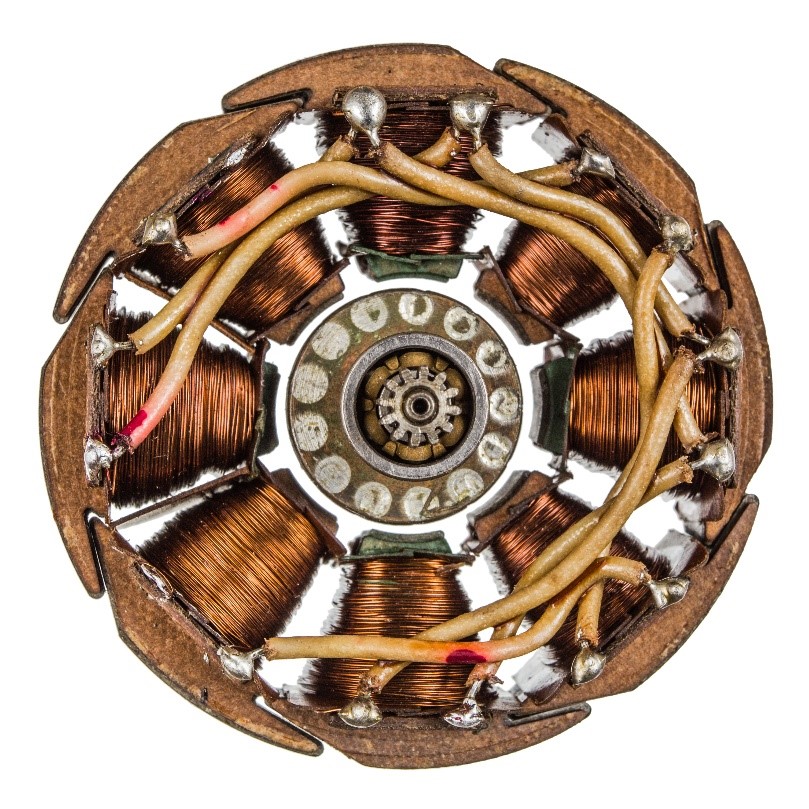
Summary: The core of the stepper motor alarm "winding open circuit" is an abnormal current loop, which needs to be checked step by step from physical wiring → motor body → driver. If self-diagnosis is difficult, it is recommended to contact the equipment manufacturer or professional maintenance personnel to prevent further damage.
1. Direct Cause Analysis of Open Stepper Motor Winding Failures.
1). Physical open circuit of motor winding: manifested as internal breakage or burning of the winding coil. Possible Causes: Motor overload causes overheating and burns out the coil; external impact or vibration causes the winding lead to break; Continuous operation under high current can accelerate insulation aging, potentially leading to short circuits and eventual coil fusing. Verification method: After powering off the motor, use a multimeter to measure the resistance of each phase winding. Normally, the resistance should range from a few ohms to serval dozen ohms. If any phase shows infinite resistance, it indicates an open circuit. Perform a visual inspection by disassembling the motor to check for signs of damage, such as burnt, blackened, or broken winding sections. 2). Wiring problem, manifested as poor contact in the motor leads or connectors. Common failure points: Broken motor lead wire (especially at frequent bending points); loose, oxidized, or intermittent connections; wrong connection between the drive output terminal and the motor phase (such as reverse connection between A+ and A). Verification method: Perform a shake test by gently shaking the motor cable to observe whether the alarm disappears intermittently; Continuity test: Use a multimeter to check the continuity of the cable; Phase check: Confirm that the motor A+/A, B+/B are consistent with the driver label. 3). Driver failure, manifested as damage to the internal power devices of the driver (such as MOS transistors, driver IC). Possible reasons: output short circuit or excessive current can cause internal components of the driver to fail or break down. Inadequate heat dissipation may lead to overheating, resulting in thermal damage or burnout of the driver circuitry. Verification method: Conduct a replacement test: Replace the driver with another unit of the same model. If the alarm no longer occurs, it confirms a fault in the original driver. Use an oscilloscope to detect the driver’s output waveform; if one phase is missing or abnormal, this indicates a malfunction in the driver’s output circuitry.2. Troubleshooting of indirect causes of stepper motor winding open circuit fault.
1). If the driver's output current is set significantly lower than the motor’s rated current, it may mistakenly trigger the open-circuit protection. This misconfiguration can cause the system to falsely interpret normal operating conditions as a winding fault. Solution: Refer to the rated current specified on the motor nameplate and adjust the driver DIP switch or software parameters to a matching value. 2). Environmental interference or inadequate grounding may result in strong electromagnetic disturbances, leading the driver to misdetect signals. Verification method: Check whether the motor cable is routed parallel to the power cable. It is recommended to use shielded cable with single-point grounding; ensure that the drive’s grounding terminal is securely connected. 3). The motor over-temperature protection may be falsely triggered due to incorrect reading from the temperature sensor, causing the drive to forcibly disconnect the motor windings. Solution: Inspect the motor's temperature control switch or thermistor for faults. (some high-end motors have built-in thermal protection components).3. Emergency treatment and repair suggestions for stepper motor winding open circuit fault.
Processing step 1: Quickly verify the motor winding 1. Disconnect the motor from the driver; 2. Use a multimeter to measure the resistance of each phase winding (for example, for a two-phase stepper motor, measure A+/A and B+/B); 3. Abnormal handling: If the resistance of a phase is abnormal, attempt to repair the broken wire or replace the motor. Processing step 2: Check the wiring and connectors 1. Re-crimp all terminals to ensure secure connections with no looseness; 2. Replace any connectors suspected of poor contact; 3. Replace aging cables with high-temperature resistant wiring. Processing step 3: Driver diagnosis 1. Connect the driver to another properly functioning motor of the same model. If the alarm persists, the driver is likely faulty; 2. Inspect the driver's internal fuse or power transistor (professional operation is required).4. Preventive measures
1). Electrical protection: Install a fuse to the power input; use a stepper driver with overcurrent protection. 2). Mechanical protection: avoid applying radial force on the motor shaft, ensure the coupling is flexibly connected. Regularly lubricate the guide rails and lead screws regularly to minimize sudden load mutations. 3). Environmental optimization: install a cooling fan or choose a high-temperature resistant motor in high-temperature environments; use an anti-vibration cable holder when the vibration is strong.5. Repair cost reference
Fault type repair plan: If the motor winding is broken, replace with a new motor; if the driver power tube is damaged, replace the driver or repair the mainboard; if the wiring contact is poor, replace the cable or connector.Summary: The core of the stepper motor alarm "winding open circuit" is an abnormal current loop, which needs to be checked step by step from physical wiring → motor body → driver. If self-diagnosis is difficult, it is recommended to contact the equipment manufacturer or professional maintenance personnel to prevent further damage.