
- Home
- Technical College
- MOTOR TECHNOLOGY
- Closed-Loop Stepper Motor Alarm: Position Error Exceeds Limit
Closed-Loop Stepper Motor Alarm: Position Error Exceeds Limit
Position errors in closed-loop stepper motors typically arise from the following causes and should be investigated step by step: 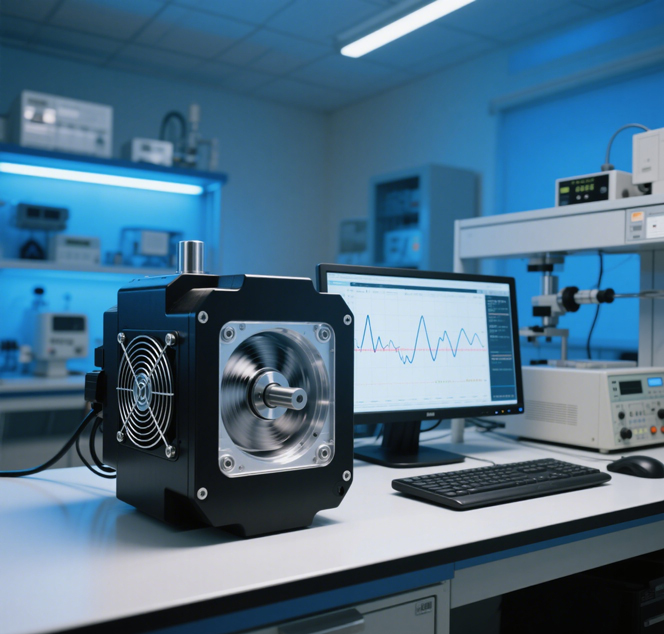
2. Motor and driver problems Insufficient motor torque: The motor cannot effectively drive the load due to improper model selection or an excessively low drive current setting. Improper drive parameter settings: Microstepping set too high. Excessive microstepping reduces high-speed torque, potentially causing dynamic step loss. Unoptimized current or speed loop parameters: Improperly tuned PID parameters can result in slow response times or overshooting during operation. Drive failure: Hardware damage causes abnormal output.
3. Encoder or feedback system abnormality Encoder signal interference: Poor wiring, damaged shielding layer or electromagnetic interference causes feedback signal distortion. Encoder damage: sensor failure or installation misalignment (such as poor concentricity), feedback data error. Mismatch between encoder and controller resolution settings: Inconsistent resolution settings between the controller and encoder can lead to position calculation errors, reducing system positioning accuracy.
4. Control signal problem Pulse frequency too high: If the pulse frequency exceeds the motor's maximum response capability, resulting in command loss. Signal interference: Pulse/direction signal may be affected by interference (such as not using shielded wires over long distances), resulting in erroneous or lost commands. Controller output abnormality: PLC or motion controller program error, sending incorrect commands.
5. Improper setting of motion parameters Acceleration and deceleration curve too steep: the instantaneous acceleration exceeds the motor load capacity, causing dynamic step loss. Position error threshold too small: An unreasonably narrow fault tolerance range can cause minor fluctuations to trigger alarms. Closed-loop control parameters not properly tuned: the position loop PID parameters (proportional, integral, differential) are not optimized for the specific load characteristics.
6. Power supply and environmental factors Voltage instability: Power supply voltage fluctuations or insufficient power lead to decreased motor torque. Temperature effects: Overheating of the motor or driver leads to performance degradation. External vibration or shock: Strong external vibrations or impacts may cause mechanical displacement or encoder misjudgment, compromising system accuracy.
7. Software or firmware issues Control algorithm defects: Flaws in closed-loop control logic—such as integral saturation or inadequate compensation for feedback delay—can result in control instability or errors. Outdated firmware version: An outdated firmware version in the driver or controller may lead to compatibility issues and should be updated promptly to the latest release.
If the closed-loop stepper motor continues to display the position error exceeding the limit, it is recommended to contact the equipment manufacturer or utilize professional diagnostic tools for further analysis.
Reasons for the displayed position error of the closed-loop stepper motor exceeding the limit.
1. Mechanical System Issues Excessive load or mechanical jamming: The motor torque is insufficient to overcome mechanical resistance (such as guide rail sticking, overtightened belts, worn gears, etc.), resulting in step loss. Mechanical resonance: At certain speeds. The mechanical structure may enter a state of resonance, causing vibration or lost steps. Loose transmission components: Looseness or slippage in components such as couplings, belts, lead screws can cause discrepancies between the actual position and the feedback signal.2. Motor and driver problems Insufficient motor torque: The motor cannot effectively drive the load due to improper model selection or an excessively low drive current setting. Improper drive parameter settings: Microstepping set too high. Excessive microstepping reduces high-speed torque, potentially causing dynamic step loss. Unoptimized current or speed loop parameters: Improperly tuned PID parameters can result in slow response times or overshooting during operation. Drive failure: Hardware damage causes abnormal output.
3. Encoder or feedback system abnormality Encoder signal interference: Poor wiring, damaged shielding layer or electromagnetic interference causes feedback signal distortion. Encoder damage: sensor failure or installation misalignment (such as poor concentricity), feedback data error. Mismatch between encoder and controller resolution settings: Inconsistent resolution settings between the controller and encoder can lead to position calculation errors, reducing system positioning accuracy.
4. Control signal problem Pulse frequency too high: If the pulse frequency exceeds the motor's maximum response capability, resulting in command loss. Signal interference: Pulse/direction signal may be affected by interference (such as not using shielded wires over long distances), resulting in erroneous or lost commands. Controller output abnormality: PLC or motion controller program error, sending incorrect commands.
5. Improper setting of motion parameters Acceleration and deceleration curve too steep: the instantaneous acceleration exceeds the motor load capacity, causing dynamic step loss. Position error threshold too small: An unreasonably narrow fault tolerance range can cause minor fluctuations to trigger alarms. Closed-loop control parameters not properly tuned: the position loop PID parameters (proportional, integral, differential) are not optimized for the specific load characteristics.
6. Power supply and environmental factors Voltage instability: Power supply voltage fluctuations or insufficient power lead to decreased motor torque. Temperature effects: Overheating of the motor or driver leads to performance degradation. External vibration or shock: Strong external vibrations or impacts may cause mechanical displacement or encoder misjudgment, compromising system accuracy.
7. Software or firmware issues Control algorithm defects: Flaws in closed-loop control logic—such as integral saturation or inadequate compensation for feedback delay—can result in control instability or errors. Outdated firmware version: An outdated firmware version in the driver or controller may lead to compatibility issues and should be updated promptly to the latest release.
Closed-loop stepper motor display position error out of limit troubleshooting steps
1. Mechanical inspection: Manually rotate the load to confirm that there is no jamming; check the tightness of the transmission parts. 2. Electrical test: Measure whether the output current of the driver is within normal range; check whether the encoder signal is stable (observe the waveform with an oscilloscope). 3. Parameter verification: Verify key parameters such as motor current, microstepping, acceleration and deceleration time; reduce the speed/acceleration to test if the error persists. 4. Interference troubleshooting: Use shielded wires and ensure good grounding; isolate interference from other high-power equipment to minimize electromagnetic interference. 5. Replacement test: Replace the motor, driver or encoder one at a time to identify potential hardware failures.Solution to the position error exceeding the limit displayed by the closed-loop stepper motor
Optimize mechanical structure: Reduce friction, reinforce transmission components, add dampers to suppress mechanical resonance. Adjust drive parameters: increase drive current, reduce microstepping, optimize PID control parameters. Enhance noise immunity measures: use twisted shielded cables and add ferrite ring filters to improve resistance to electromagnetic interference. Reset motion parameters: extend acceleration and deceleration time, and appropriately increase the position error threshold.If the closed-loop stepper motor continues to display the position error exceeding the limit, it is recommended to contact the equipment manufacturer or utilize professional diagnostic tools for further analysis.